Shopify, and the Thing People Keep Saying About It
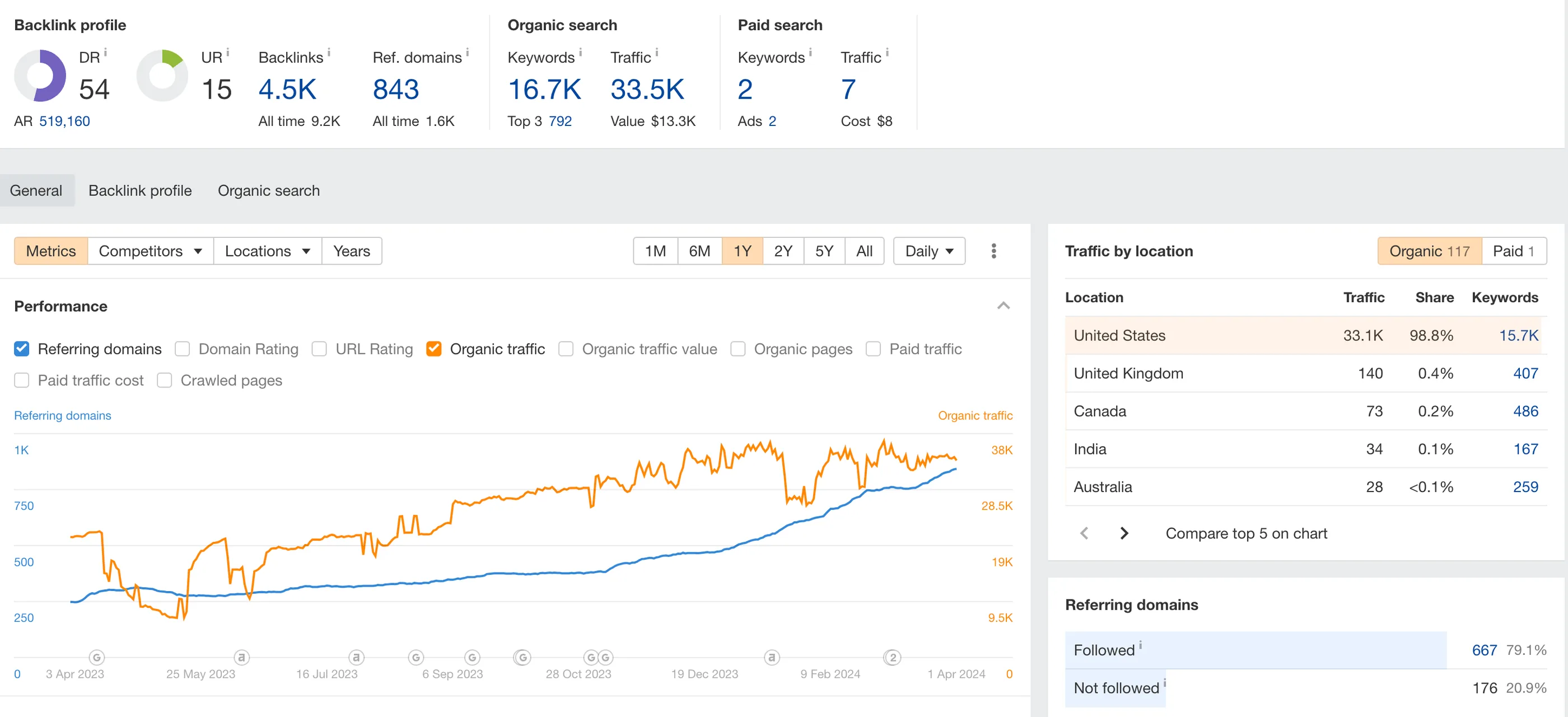
Somebody will tell you that Shopify cannot rank. This store holds 792 terms in the first three organic results, which is the highest count of any ecommerce project on this site.
Organic traffic
33.5K
sessions a month, Ahrefs estimate
Traffic value
$13.3K
to buy the same as ads, monthly
- Terms in the top three
- 792
- Keywords ranking
- 16.7K
- Domain Rating
- 54
- Referring domains
- 843
One year to April 2024. Shopify.
- United States 98.8%
- United Kingdom 0.4%
What the panel shows
Ahrefs records 33,500 organic sessions a month across 16,700 ranking keywords. Domain Rating is 54, the strongest here, on 843 referring domains and 4,500 backlinks. Estimated traffic value is $13,300 a month.
The window is twelve months to April 2024. Traffic started around ten thousand and finished at thirty three and a half.
The dip before the climb
The first two months of the window go down, not up. Traffic falls from roughly ten thousand to about seven before it turns, and it does not clear its starting point again until around the third month.
That shape is common enough after structural work on an ecommerce site and it is worth naming, because it is the point where a client who was promised a smooth line starts asking difficult questions. Consolidating thin collection pages, changing URL structures or fixing duplicate variant pages all cost traffic before they pay it back. Anyone selling this work without warning about the trough is setting up an argument for month two.
Why the platform argument is mostly noise
Shopify constrains some things. URL structures are rigid, the blog is weak, and collection filtering generates parameter URLs that need handling. None of that prevents ranking, and this panel is the evidence.
What actually decides an ecommerce result is whether the collection pages answer a buying question, whether the variant and filter sprawl is under control, and whether the product content says anything a manufacturer's datasheet does not. Those are all available on Shopify. The ecommerce SEO page goes through them.
What it does not tell you
Revenue, conversion rate, or margin. A jewellery store can triple its sessions and sell no more rings if the additional traffic arrived on informational pages.
The audience is 98.8% United States, which is about as single market as this set gets, so it carries no read on bilingual trading either way.
The panel also cannot separate branded searches from the rest. A store with 843 referring domains has some brand recognition, and some share of those 33,500 sessions is people typing the name rather than discovering it.
If you run a Shopify store here
If you run a Shopify store here and have been told the platform is the problem, ask for the specific limitation and what it costs, rather than accepting the general claim. Usually the real constraint is that nobody has written the collection pages.
And budget for the dip. The published prices on the SEO packages page assume a three month minimum for exactly this reason.